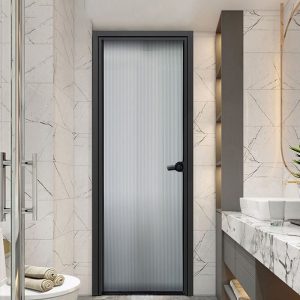
Aluminum alloy windows and doors are primarily composed of four main material categories: aluminum alloy profiles, glass, hardware accessories, and auxiliary materials. Let’s delve into the performance characteristics of each of these materials:

Aluminum Alloy Profiles
Aluminum alloy profiles are one of the main materials used in windows and doors. They serve as the primary assembly and load-bearing components. Based on the installation position of aluminum alloy profiles, they can be categorized into four types: frame material, sash material, intermediate support material (horizontal bar material), and door and window pressure lines. The specific distinctions among these four types of materials are outlined in the below:
Frame Material

Assembled through frame material, the aluminum alloy door and window frame are connected to the wall, securing the position of the door and window.
Sash Material

Assembled through the intermediate components, aluminum alloy door leaves and window leaves are formed. They are connected to the door and window frames using hardware accessories.
Intermediate Support Material (Horizontal Bar Material)

By connecting to the outer frame, the doors and windows are separated, which also strengthens the overall strength of the doors and windows.
Door and Window Pressure Lines

Connecting through the pressure line with the frame material and fan material serves to secure the casement and fixed glass.
Window And Door Assembly Nodes Diagram


Difference between Standard and Thermal Break Aluminum Alloy Profiles
Aluminum alloy profiles can be divided into Standard Aluminum Alloy Profiles and Thermal Break Aluminum Alloy Profiles.

Standard Aluminum Alloy Profiles
The profile is a single entity, extruded as a whole from the profile extrusion machine.

Thermal Break Aluminum Alloy Profiles(Strip)
Thermal break aluminum profiles consist of two aluminum alloy profiles and one thermal insulation strip. After the extrusion of the two profiles, the thermal insulation strip is threaded into the profiles using a threading machine, making the two segments of profiles integral. These profiles are used for doors and windows with high requirements for thermal insulation and energy efficiency.

Thermal Break Aluminum Alloy Profiles(Rubber)
First, use an extrusion machine to extrude aluminum alloy profiles. Next, inject liquid thermal insulation rubber into the standard grooves. After cooling, trim the connected profiles to create thermal break aluminum profiles, which are used for doors and windows with high requirements for thermal insulation and energy efficiency.
Surface Treatment Of Aluminum Alloy Profiles
Aluminum alloy profiles can be categorized based on their surface treatment methods, which include fluorocarbon spraying, powder coating, anodization, and electrophoresis.
Among these four surface treatment methods, the ones commonly used are powder coating and electrophoresis.
Fluorocarbon Spraying
- Service Life: 25~30 Years
- Color Selection: Multicolour
- Repairability: Repairable
- Corrosion Resistance: Corrosion Resistant
Powder Coating
- Service Life: 10 Years
- Color Selection: Multicolour
- Repairability: Can be repaired with polyurethane paint
- Corrosion Resistance: Corrosion Resistant
Anodization
- Service Life: 20 years
- Color Selection: Monochromatic
- Repairability: Not Repairable
- Corrosion Resistance: Corrodes Easily
Electrophoresis
- Service Life: 30 Years
- Color Selection: Monochromatic
- Repairability: Not Repairable
- Corrosion Resistance: Corrosion Resistant
How To Choose High-Quality Aluminum Profiles
1.Smooth Surface: High-quality aluminum profiles exhibit a flat and smooth surface texture.
2.Consistent Color: Profiles from the same batch should have uniform surface treatment colors without noticeable discrepancies.
3.No Surface Deformities: There should be no dents or protrusions on the surface of aluminum alloy profiles.
4.Defect-Free Appearance: The surface of aluminum alloy profiles should be free from open bubbles (white spots), slag (black spots), cracks, burrs, or peeling.
Hardware Accessories
Hardware accessories play a crucial role in the operation, closure, and fixation of aluminum alloy doors and windows. Different window types can be equipped with varying hardware accessories to meet specific requirements.
Hardware Accessories Of Swing Windows

Hinge
Hardware accessories for fixing the window sash to the window frame and enabling its opening and closing. Choose either hinges or pivot hinges. Generally, we opt for hinges.
Hinge
Hardware accessories for fixing the window sash to the window frame and enabling its opening and closing.


Handle
Hardware accessories for locking and opening window sashes.
Clutches And Locking Point
These clutches play a crucial role in enabling the opening and closing of doors and windows by conveying instructions from the handle lock to the locking points.
It’s essential to ensure proper coordination between the handle lock, clutches, and locking points for the efficient operation of doors and windows.


Rubber
When closing, the window returns to its original position, improving airtightness and water tightness. It is installed on the lower part of the casement and the upper part of the lower frame.
Hardware Accessories Of Swing Doors

Hinge
Hardware accessories for fixing the window sash to the window frame and enabling its opening and closing.
Handle
Hardware accessories for locking and opening window sashes.


Clutches And Locking Point
These clutches play a crucial role in enabling the opening and closing of doors and windows by conveying instructions from the handle lock to the locking points.
Hardware Accessories Of Awning Windows

Hinge
Hardware accessories for fixing the window sash to the window frame and enabling its opening and closing.
Handle
The accessories for locking and opening window sashes. Depending on the project requirements, either handles or handle locks are chosen. Handles are mainly used in apartments, while handle locks are preferred for villas.


Handle, Clutches And Locking Point
Accessories for locking and opening window sashes. Handle locks, along with actuators and locking points, need to be used in combination.
These clutches play a crucial role in enabling the opening and closing of doors and windows by conveying instructions from the handle lock to the locking points.
Hardware Accessories Of Sliding Windows

Lock
Accessories for locking and opening sliding windows.
Roller
The sliding transmission components for push-pull windows are equipped with single-wheel rollers.

Hardware Accessories Of Sliding Doors

Lock
Accessories for locking and opening sliding doors.
Handle
Easy to push and pull.


Roller
The sliding transmission components for push-pull doors are equipped with double-wheel Rollers.
Other Accessories

Hinge Support
When the width of the top-hung window exceeds 800 mm, or when it’s not possible to install a door closer on a casement door, or when a casement window uses hinges, additional configuration is required.
Door Closer
It ensures the controlled closing of doors, preventing them from standing open, slamming shut, or being pulled open by strong winds.

Glass
The largest part of aluminum alloy doors and windows is glass, and due to insulation and energy-saving requirements, the minimum recommended configuration for insulated glass is 5+6A+5. Depending on the specific building structure type, window-to-wall ratio, and energy calculations, different projects may require varying hollow layer thicknesses and glass thicknesses.
Depending on the window type and window size, different glass thicknesses may be required for various window types within the same project. Generally, as the glass area increases, the required glass thickness also tends to be higher.
Common types of glass used for residential windows and doors: Tempered Glass, Laminated Glass, Low-E Glass, and Coated Glass.
Types Of Glass For Windows And Doors
1.Single-Pane Glass: Single-pane glass refers to a single layer of glass without any additional features. It is commonly used in older windows but lacks energy efficiency.
2.Insulated Glass: Insulated glass, also known as double-glazed or dual-pane glass, consists of two glass panes separated by an air or gas-filled space. It provides better insulation and noise reduction compared to single-pane glass.
3.Tempered Glass: Tempered glass is heat-treated to increase its strength. When broken, it shatters into small, blunt pieces, reducing the risk of injury. It is commonly used for safety purposes.
4.Double-Glazed Insulated Glass: This type of glass combines the benefits of tempered glass and insulated glass. It has two tempered glass panes with an insulating layer in between, providing enhanced safety and energy efficiency.
5.Laminated Glass: Laminated glass consists of two or more layers of glass bonded together with an interlayer (usually PVB, SGP, EVA, or PU). It provides safety benefits, as even when shattered, the glass remains held together by the interlayer. Laminated glass is commonly used for sound insulation and UV protection.
6.Low-E Glass: Low-E (low-emissivity) glass has a thin coating that reflects infrared light while allowing visible light to pass through. It enhances energy efficiency by reducing heat transfer, making it suitable for both hot and cold climates.
Safety Glass Configuration Requirements
1.Glass area ≥ 1.5 square meters.
2.Floor-to-ceiling windows with a final decorative surface at the bottom edge ≤ 500 mm.
3.External-opening windows on the 7th floor and above.
4.Tilted assembly windows and skylights.
5.Locations susceptible to impact or collision, such as all doors and fixed floor-to-ceiling glass.
Performance Characteristics Of Insulated Glass, Laminated Glass, And Low-e Glass
Insulated glass:
The performance characteristics of insulated glass compared to regular single glass.
Insulated glass consists of two or more glass panes separated by a dry gas (such as argon or krypton) and sealed with a high-strength, high-airtight composite adhesive.
Insulated glass provides better thermal insulation, and soundproofing, and prevents frost formation on the glass surface.
Laminated glass:
When using laminated glass, its primary applications are related to safety and security. Here’s why laminated glass is preferred in certain scenarios:
Cutting Resistance: Laminated glass cannot be effectively cut using a glass cutter once it is installed. Attempting to break laminated glass with other tools (such as a hammer) is time-consuming and noisy. As a result, cutting or shattering laminated glass to gain unauthorized entry indoors is extremely difficult and likely to be noticed.
Enhanced Security: Laminated glass provides stronger resistance against malicious damage, theft, and violent intrusion.
It acts as a deterrent due to the challenges posed by breaking through it. Common applications include entry doors for residential units (especially those with security requirements). Recommended configurations for security unit doors often include laminated glass with specifications like 8 mm tempered glass + 1.14 mm PVB interlayer + another 8 mm tempered glass.
Safety Considerations: Laminated glass remains intact even after breaking, preventing glass shards from falling. Therefore, it is suitable for locations like balcony glass panels, canopies, and skylights where broken glass could pose a risk of injury.
Low-E glass:
Low-E glass is a type of coated glass where multiple layers of metal or other compounds are applied to the glass surface. It has high visible light transmittance and high reflectance for infrared radiation, especially in the mid-to-far infrared range. This makes it an excellent choice for thermal insulation.
In practical applications, the use of Low-e glass is primarily driven by its superior insulating properties. In southern regions, it helps prevent excessive solar heat from radiating into indoor spaces during the summer. Therefore, the Low-e coating should be positioned on the outdoor side of the glass. Conversely, in northern regions, the goal is to prevent heat loss during winter. In this case, the Low-e coating should be positioned on the indoor side of the glass.
Low-e glass ability to minimize heat transfer through radiation. By controlling the passage of heat and light, and contributes to energy efficiency and comfort in buildings.
Thermal Conductivity Coefficients Of Various Types Of Glass K-value (U-value)
1.Single Glass: 5.5 K-value (U-value)(w/m2k)
2.Single Low-E Glass:3.65~3.0 K-value (U-value)(w/m2k)
3.Insulated Glass (5+12A+5):3.0 K-value (U-value)(w/m2k)
4.Low-E Glass (5+12A+6LE):2.3~1.8 K-value (U-value)(w/m2k)
5.Low-E Glass (5+12A+6LE):1.8~1.4 K-value (U-value)(w/m2k)
Methods Of Testing Tempered Glass And Low-e Glass
Test of Tempered Glass
Tempered Glass: The identification of tempered glass primarily relies on the presence of a tempered mark. If you have doubts about glass with the tempered mark, you can use a glass stress intensity tester. Generally, the surface stress intensity of tempered glass should be above 95 MPa.
Tempering Process: Tempered glass is created by heating ordinary glass to around 650°C and then rapidly cooling it. This process induces internal stress within the glass, enhancing its strength. It is important to note that tempered glass is different from semi-tempered glass.
Semi-Tempered Glass: Semi-tempered glass undergoes a different processing method compared to fully tempered glass. While tempered glass is rapidly cooled, semi-tempered glass is allowed to cool naturally. The stress level in semi-tempered glass typically ranges from 24 to 69 MPa.
Safety Considerations: It’s essential to understand that semi-tempered glass does not fall under the category of safety glass. Unlike fully tempered glass, semi-tempered glass lacks the 3C certification mark. After breakage, its characteristics are similar to those of ordinary glass, and it does not provide the same safety protection.
Test Of Low-e Glass
Low-e glass, also known as low-emissivity glass, can be tested using a simple method involving a lighter. Here’s how it works:
Lighter Test Method:
1.Stand in front of the glass you want to test.
2.Ignite the lighter and observe the flame’s reflection on the glass.
3.If the glass has a Low-e coating, you’ll notice that the reflected flame from the Low-e layer appears distinctly different in color compared to the other layers.
4.Typically, the Low-e flame reflection may have a subtle blue or gray tint, while the other reflections remain red or yellow.
Refer to the image below for a visual representation:

Several Auxiliary Materials
In the context of aluminum alloy doors and windows, besides the primary materials such as profiles, hardware components, and glass, there are several auxiliary materials used to complete the fabrication and installation process.
Here’s a list of the main auxiliary materials:
Sealant

Sealant is used for sealing gaps between window frames and walls, sealing joints between profiles, and sealing the interface between glass and profiles. Its purpose is to provide effective sealing and waterproofing.
Structural Adhesive
The Structural adhesive is used to create load-bearing joints, particularly at corners where the glass meets or between large parallel glass panels. Its purpose is to provide structural stability and fixation

Foam Sealing Agent

A foam sealing agent is used to create a flexible connection and secure aluminum alloy frames in the gaps between the frame and the opening.
Sealing Strips
Sealing strips are commonly used around the edges of hinged windows and door frames. They come in various cross-sectional shapes, with the most common being circular and tongue-shaped. Circular sealing strips provide better coverage when doors and windows are closed, enhancing airtightness and water resistance compared to tongue-shaped strips. Therefore, circular strips are generally preferred for this purpose.

Weather Strips

Weather strips are commonly used in sliding doors and windows to provide a seal when they are closed, enhancing airtightness and water resistance
Stainless Steel Screws
These are commonly used for assembling door and window frames.
They come in various types, including self-drilling screws and self-cutting screws.
Stainless steel screws are known for their corrosion resistance and durability.

What are self-tapping screws?
Self-Tapping screws are often used for installing hardware components such as friction hinges. They have a threaded design that allows them to create their threads when driven into wood or other materials. Self-tapping screws eliminate the need for pre-drilling, saving time and labor costs. They provide a secure grip and prevent loosening.
Galvanized Steel Components

Galvanized steel components are used within intermediate profiles to enhance strength and provide reinforcement. Galvanized steel is a type of steel coated with a layer of zinc to protect it from corrosion. The zinc layer acts as a sacrificial barrier, preventing the underlying steel from rusting.