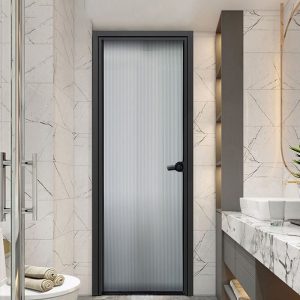
When buyers compare aluminum windows and doors, attention often goes first to appearance, frame color, opening style, or price. Those details matter, but they do not tell the full story.
The performance of an aluminum window or door depends on a group of components working together. A typical system includes aluminum profiles, glass, operating hardware, seals, fasteners, structural components, and installation materials. The frame carries loads, the glass controls light and part of the thermal performance, the hardware manages movement and locking, while gaskets and sealants help control air and water penetration.
For residential developments, hotels, apartment buildings, offices, storefronts, and other commercial projects, understanding these components makes it easier to compare quotations on an equal basis.
A lower-priced window is not necessarily the same product at a better price. It may simply use a different frame system, thinner or simpler glazing, less demanding hardware, or a different sealing specification.

Aluminum Profiles Form the Structural Base of the Window
Aluminum profiles are among the most important components in an aluminum window and door system because they form the frame and sash and carry much of the structural load.
A typical window can contain several different profile types.
The outer frame connects the window to the building opening and establishes its position. Sash profiles create the operable portion of a casement or sliding window. Mullions and transoms divide larger openings and can also contribute to the overall strength of the assembly. Glazing beads secure the glass within the frame or sash. The source document distinguishes these different profile functions rather than treating the aluminum frame as a single piece.
This matters when evaluating custom aluminum windows.
Two products may have nearly identical exterior dimensions but use very different internal profile designs. One may be intended for a relatively small fixed opening, while another may be engineered for a larger operable sash, heavier insulated glass, or a more demanding façade condition.
For this reason, professional buyers should not compare aluminum windows only by profile width.
The more useful questions are:
What system is being used?
How is the sash supported?
How are large openings divided?
What glass weight can the system accommodate?
How are the corners assembled?
How are drainage and sealing handled?
These details have more practical value than a single frame dimension.
Standard Aluminum vs Thermal Break Aluminum
One of the most important distinctions in aluminum window construction is the difference between a standard aluminum profile and a thermal break profile.
A standard profile is essentially one continuous aluminum section. A thermal break profile separates the interior and exterior aluminum portions with a lower-conductivity material.
The uploaded document describes two thermal-break approaches: a European-style strip system in which separate aluminum sections are joined with an insulating strip, and an injected thermal-break method in which insulating material is introduced into a prepared section of the profile. Both are intended for windows with higher thermal-insulation requirements.
This distinction is particularly relevant for energy-efficient aluminum windows and doors.
Aluminum itself conducts heat efficiently. A thermal break reduces the direct thermal path through the metal frame, which can improve the thermal behavior of the complete window system when combined with suitable glazing.
However, the term “thermal break” should not be treated as a performance rating by itself.
Final performance also depends on the profile geometry, insulating barrier, glass construction, spacer, seals, sash design, and installation.
For architects, contractors, and commercial window buyers, the better approach is to define the required performance first and then select the frame and glazing system capable of meeting it.
Surface Finish Is More Than a Color Choice
Aluminum profiles can receive different architectural finishes.
The document discusses fluorocarbon coating, powder coating, anodizing, and electrophoretic finishing, with powder coating and electrophoretic finishing identified as commonly used methods in the source material.
From a buyer’s perspective, the finish affects more than appearance.
It can influence:
surface consistency,
color uniformity,
resistance to environmental exposure,
maintenance requirements,
and the overall appearance of repeated windows across a building.
The document also identifies practical visual characteristics of good-quality aluminum profiles: a smooth surface, consistent color within the same batch, and the absence of obvious depressions, bubbles, cracks, burrs, peeling, or other visible defects.
These are useful quality-control points for bulk aluminum window orders.
For a commercial development with hundreds of repeated units, even small color differences can become obvious once the products are installed across one facade.
Glass Often Makes Up Most of the Visible Window Area
The frame receives a lot of attention, but glass usually makes up the largest portion of a window.
That means glass selection has a major influence on safety, thermal performance, acoustics, appearance, daylight, and overall project cost.
The source document identifies several common glass categories used with aluminum windows and doors, including ordinary insulated glass, tempered glass, laminated glass, and Low-E glass. It also notes that glass thickness can vary within the same project depending on window type and glass area; larger glass areas generally require greater attention to glass thickness and structural calculation.
This is an important point for anyone buying large commercial windows, storefront glazing, or oversized residential windows.
There is no single glass thickness that is automatically suitable for every opening.
The right specification depends on dimensions, support conditions, loading, glass type, and project requirements.
Tempered Glass: Safety First
Tempered glass is frequently used in aluminum windows and doors where safety glazing is required.
The source explains that tempered glass is created by heating ordinary glass and then cooling it rapidly, creating internal stresses that increase its strength. It also distinguishes tempered glass from heat-strengthened glass, noting that they should not be treated as identical safety products.
For buyers, one important principle is:
Tempered glass is primarily a safety glass solution, not a complete performance specification.
It does not automatically mean that a window is highly energy efficient, highly acoustic, intrusion resistant, or suitable for every structural condition.
A commercial entrance door, a full-height fixed panel, a skylight, and an office window may all require different glass solutions.
That is why the specification should start with the location and function rather than simply asking for “tempered glass windows.”
Laminated Glass Adds Glass Retention
Laminated glass consists of two or more pieces of glass bonded with an interlayer.
The document describes laminated glass mainly in terms of safety and security. Because the interlayer holds the glass together after breakage, laminated glass is useful in applications where falling fragments or easy penetration are concerns.
This can make laminated glass relevant for applications such as:
commercial entrance glazing,
selected security-sensitive locations,
overhead or inclined glazing,
balustrade-related applications,
and projects where glass retention after breakage is important.
Again, the right choice depends on the project.
Tempered glass and laminated glass are not simply “good” and “better.” They have different characteristics and can also be combined in more complex insulated glazing systems.
Insulated Glass Improves More Than Thermal Performance
Insulated glass units use two or more panes separated by a sealed cavity.
The uploaded document notes that insulated glass offers better thermal insulation and sound insulation than ordinary single glazing and can also reduce surface frosting under suitable conditions.
For modern aluminum windows and doors, insulated glass is therefore commonly considered when buyers need improved indoor comfort.
But simply stating “double glazing” is still not enough to compare two suppliers.
A detailed quotation should identify the glass build-up.
For example:
glass thickness,
cavity width,
whether either pane is tempered,
whether laminated glass is used,
whether a Low-E coating is included,
and whether the system uses a specific spacer or gas fill.
Without that information, two quotations described as “double-glazed aluminum windows” may represent very different products.
Low-E Glass and Energy-Efficient Aluminum Windows
Low-E, or low-emissivity glass, uses a thin coating designed to modify the way heat radiation passes through the glazing.
The source explains that Low-E glass has relatively high visible-light transmission while reflecting a significant portion of infrared radiation, which is why it is used for improved thermal performance.
The technical examples in the document also show a clear pattern: the listed U-values for conventional single glazing are substantially higher than the listed values for Low-E insulated glass configurations. The document gives conventional 5 mm clear glass at about 5.5 W/m²K, ordinary 5+12A+5 insulated glass at about 3.0 W/m²K, and selected Low-E insulated configurations in the approximate 1.4–2.3 W/m²K range. These are source-document examples rather than universal ratings for every modern product.
The broader lesson remains useful:
Glass configuration can significantly change thermal performance.
A buyer should therefore avoid comparing quotations based only on the words “aluminum window” or “Low-E glass.”
The complete configuration matters.
Hardware Determines How the Window Actually Works
Hardware is sometimes treated as a minor accessory. In reality, it directly affects how an operable aluminum window or door opens, closes, locks, seals, and feels during daily use.
The document identifies a wide range of hardware depending on opening type, including friction stays, hinges, handles, locking points, transmission mechanisms, lifting blocks, compression components, rollers, hook locks, and door closers.
Different window types need different hardware.
Casement windows rely on hinges or friction stays together with locking hardware. Sliding windows depend heavily on rollers and locks. Sliding doors use heavier-duty rolling and locking components. Swing doors require hinges and locking systems, and selected entrance doors may also use door closers.
Some hardware components also contribute indirectly to air and water sealing by helping pull the sash tightly into the frame when the window is closed. The source specifically notes this function for lifting and compression-related components.
For commercial windows and doors, this becomes even more important because usage intensity can vary significantly.
A small office window that opens occasionally does not face the same operating demands as a heavily used commercial entrance door.
Hardware should therefore be selected according to:
opening size,
sash or door weight,
frequency of use,
locking requirements,
and the operating system.
Seals, Gaskets and Sealants Are Small Components With a Large Job
The quality of an aluminum window does not end with the frame, glass, and hardware.
Secondary materials can have a major influence on installation and weather sealing.
The source document lists neutral silicone sealant, structural silicone, polyurethane foam, EPDM sealing gaskets, weather strips, stainless-steel fasteners, and galvanized steel reinforcement among the auxiliary materials used in aluminum window and door construction.
EPDM gaskets, for example, are compressed when a casement window or door closes, helping improve air and water tightness. The document specifically notes the sealing function of these gasket systems.
Sliding systems use different sealing approaches because the sash needs to move along a track.
This illustrates an important engineering principle:
Good sealing must match the opening method.
A casement window, sliding window, sliding door, and entrance door should not be expected to use identical sealing details.
Why Material Approval Matters on Large Projects
For a single window, material variation may be inconvenient.
For 500 or 1,000 windows, it can become a project-management problem.
The document recommends a material sample approval process in which key materials are submitted and confirmed before larger-scale supply. Sample categories include aluminum profile sections, glass, hardware, sealing strips, sealants, fasteners, and other accessories.
This approach is highly relevant to commercial window and door procurement.
An approved sample board or mock-up creates a reference for:
profile finish,
glass type,
hardware,
gasket material,
sealant,
and other visible or functional components.
For large developments, this can reduce misunderstandings between drawings, quotations, samples, and production.
Quality Control Should Be Based on Specifications, Not Adjectives
Terms such as “high quality,” “premium,” and “heavy duty” are common in window marketing.
They are also difficult to verify.
A stronger procurement process converts those adjectives into measurable requirements.
For example:
Instead of “high-quality frame,” specify the aluminum system and required finish.
Instead of “good glass,” specify the glazing construction.
Instead of “premium hardware,” identify the operating system and required performance.
Instead of “waterproof window,” define the relevant test or project requirement.
Instead of “energy-saving glass,” define the required thermal and solar performance.
The source document reflects this same general approach in its material-inspection section, where profiles, hardware, glass, sealants, gaskets, screws, and steel reinforcement are checked against specific technical requirements rather than visual marketing descriptions alone.
How to Compare Aluminum Window Suppliers More Accurately
The most reliable way to compare manufacturers is to issue the same specification to each supplier.
For example, define:
the same opening sizes,
the same window and door types,
the same aluminum system,
the same glass configuration,
the same hardware requirements,
the same finish,
the same quantity,
and the same packing or delivery terms.
Then compare the quotations.
This is especially important for commercial windows and doors, apartment developments, hotels, and residential projects with repeated openings.
If one supplier quotes ordinary aluminum with basic glazing while another quotes thermal-break profiles with Low-E insulated glass and upgraded hardware, the two prices are not directly comparable.
The goal should be:
Same Specification + Same Quantity + Same Commercial Terms = Meaningful Price Comparison
A well-designed aluminum window is not simply an aluminum frame holding a piece of glass.
It is a coordinated system.
The aluminum profiles create the structure. The glass provides safety, daylight, thermal control, and other required functions. Hardware controls movement and locking. Gaskets, sealants, fasteners, and reinforcement materials help the complete system perform as intended.
For homeowners, contractors, architects, developers, and commercial buyers, understanding these components makes supplier selection much easier.
Instead of asking only:
“How much is your aluminum window per square meter?”
a better question is:
“What exact aluminum, glass, hardware, sealing, and performance specification is included in your price?”
That single change turns a price inquiry into a much more useful product comparison.