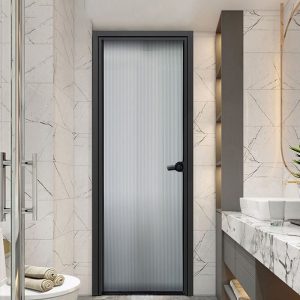
Aluminum windows and doors are widely used in houses, apartments, hotels, offices, and commercial buildings because they combine structural strength, design flexibility, relatively low maintenance, and a wide choice of architectural finishes.
But choosing a good aluminum frame does not automatically guarantee a good finished window.
Many problems that appear after a building is occupied are related not simply to the aluminum itself, but to how the complete window system is designed, manufactured, assembled, sealed, and installed.
The source document focuses on several recurring quality problems found during aluminum window and door construction: water leakage around frames and joints, insufficient frame rigidity, water collecting in sliding-window tracks, and premature hardware problems.
These issues provide a useful lesson for architects, contractors, developers, and buyers:
A reliable aluminum window is a complete system. Frame profiles, joints, anchors, drainage, sealants, glass, hardware, and installation workmanship all need to work together.

Why Do Aluminum Windows Leak Around the Frame?
Water leakage is one of the most frustrating problems associated with poorly installed windows.
The water may appear around the lower corners of the frame, at the connection between the window and wall, or where sections of a large combination window are joined.
According to the source document, two recurring causes are cracks or inadequately sealed gaps between the window frame and wall, and poorly designed or unsealed joints between sections of combination windows.
The problem is therefore not necessarily the aluminum profile.
It is often the interface.
A window can have good glass, strong aluminum, and reliable hardware and still leak if rainwater finds an uncontrolled path through a perimeter or assembly joint.
This is why aluminum window waterproofing should be considered during both product design and installation.
Good Joint Design Is the First Defense Against Water
Large windows and combination window systems may require multiple aluminum sections to be connected together.
Those joints need to be designed intentionally.
The source recommends reducing unnecessary profile joints and using suitable interlocking or overlapping connections rather than simply placing two flat profile surfaces together. It also emphasizes continuous sealing at exposed connections and around relevant fasteners.
The broader principle is particularly useful:
Do not expect sealant to compensate for poor joint design.
A good joint should combine appropriate geometry, mechanical connection, and sealing.
This becomes increasingly important on large apartment or commercial projects where hundreds of windows may use the same detail. One poorly designed joint repeated 500 times can create a much larger problem than a single installation defect.
The Window-to-Wall Connection Must Accommodate Movement
A window frame and the surrounding wall are different materials.
They do not necessarily react to temperature changes in exactly the same way.
The source notes that differences in thermal movement can contribute to fine cracks developing where the aluminum frame meets the wall. It therefore calls for an elastic connection and continuous perimeter sealing rather than relying on a rigid interface alone.
This is an important concept in modern window installation.
The perimeter joint is not merely an empty space that needs to be filled. It is the transition between the manufactured window and the building envelope.
Its design may need to address movement, air sealing, water management, insulation, and compatibility between materials.
The exact installation detail should always follow the specific window system, wall construction, project drawings, sealant manufacturer’s instructions, and applicable local requirements.
Why Does an Aluminum Window Frame Feel Loose?
Another common complaint is movement.
A window may shake when it is opened or closed. The frame may visibly move when pushed. Large combination windows may feel insufficiently rigid.
The source identifies three broad causes: an undersized or insufficiently robust aluminum profile, inadequate fixing between the frame and wall, and poorly designed connections within combination window assemblies.
These causes demonstrate why selecting an aluminum window by appearance alone is risky.
Two profiles can look similar from several meters away while having different cross-sectional geometry, dimensions, wall thicknesses, reinforcement strategies, and structural capabilities.
Likewise, even a sufficiently strong frame can perform poorly if the anchors connecting it to the building are inadequate.
The correct solution starts with the project requirements.
Window dimensions, opening type, installation height, glass weight, wind conditions, frame configuration, mullion arrangement, and anchoring conditions may all influence the final system.
Bigger Windows Require More Than Bigger Glass
Contemporary architecture increasingly favors large openings and expansive glazing.
But increasing a window’s dimensions changes more than its appearance.
The frame spans become longer. Glass becomes heavier. Wind loads acting on the opening become more significant. Mullions and transoms may need greater capacity, while connections between individual window sections become increasingly important.
For combination windows, the source specifically emphasizes appropriate mullions and intermediate members to maintain overall rigidity, together with secure connections between the components.
This is why there should never be a universal answer to questions such as:
“How large can you make this aluminum window?”
The answer depends on the actual system and project conditions.
For custom projects, manufacturers should evaluate the complete opening rather than simply scale up a smaller window.
Anchoring Is Part of the Window System
A window frame needs a reliable path for transferring loads into the surrounding structure.
That makes fixing points, anchors, brackets, and substrate conditions important parts of aluminum window installation.
The source provides specific fixing distances and material dimensions for the construction practice it describes, including limits on the distance between connectors and window corners.
Those dimensions should not be treated as universal specifications for every project. Requirements can vary according to the window system, frame size, building structure, wind load, local building code, and anchor manufacturer.
The more useful lesson is this:
Anchor design should be specified—not improvised on site.
A contractor should know what the frame is being fixed to, what fastener is required, where the fixing points belong, and how the frame will remain correctly aligned while those fasteners are installed.
Why Does Water Collect in a Sliding Window Track?
Sliding windows present another characteristic water-management challenge.
Because the lower track contains channels for the moving sash, some water can enter areas designed to collect and drain it.
That does not automatically mean the window has failed.
The problem begins when the water cannot escape.
The source identifies missing or blocked drainage openings as a major reason water remains in the lower sliding track and can subsequently be driven toward the interior under wind pressure.
This distinction is essential:
A good sliding window does not rely only on keeping every drop of water out of every frame cavity. It also needs a controlled way to manage and discharge water.
Drainage is therefore part of the window design.
Never Block the Drainage Openings
Drainage holes can be small, which makes them surprisingly easy to block.
Sealant, mortar, dust, packaging material, or other construction debris can interfere with the drainage path.
The source specifically warns against blocking drainage openings when installing glass or applying sealant. It also recommends cleaning debris from sliding-window tracks after installation and checking whether collected water drains correctly.
For contractors and project inspectors, this creates a straightforward quality-control procedure.
Inspect the track.
Locate the drainage paths.
Remove construction debris.
Check that sealant has not covered them.
Confirm that water can move toward the exterior as intended.
This simple inspection can prevent problems that might otherwise be blamed on the entire window system.
Hardware Quality Affects the Life of the Window
Aluminum gets much of the attention when buyers compare windows, but users interact with the hardware every day.
Handles are turned. Locks engage and disengage. Sliding rollers repeatedly carry the weight of the sash. Hinges and stays support operable windows through thousands of opening and closing cycles.
The source identifies poor hardware selection and inadequate fixing strength as causes of hardware becoming loose, damaged, or difficult to operate. 铝合金门窗制作安装中质量通病的防治
The correct hardware therefore needs to match the window.
A small residential window and a large double-glazed sliding sash do not impose the same demands on rollers or other operating components.
The source specifically recommends more capable roller arrangements for wider sliding windows or windows using double glazing and calls for stainless steel rather than aluminum for friction-stay hinges in the application it describes.
The wider purchasing lesson is more important than any single hardware specification:
Hardware should be selected according to sash size, glass weight, opening type, operating frequency, and required performance.
Smooth Operation Is a Quality Indicator
One of the easiest ways to evaluate a finished window is also one of the most useful.
Operate it.
A properly configured window should open, close, and lock without unnecessary force. A sliding sash should move smoothly. Handles and locks should align correctly. Hinges, stays, and rollers should feel secure rather than loose.
The source recommends installing hardware in the correct sequence and checking that its final position allows flexible operation.
Difficult operation should not automatically be dismissed as something that will “loosen up later.”
It can indicate poor adjustment, inappropriate hardware, frame distortion, incorrect installation, or a mismatch between sash weight and the selected hardware.
For project inspection, opening and closing each operable type is therefore an important functional test.
Quality Control Should Begin Before Installation
Many window problems that appear on site originate much earlier.
If the aluminum profile is undersized for the opening, an installer cannot solve that problem with additional sealant.
If a combination window has an inadequate structural joint, better cosmetic finishing will not correct the fundamental design.
If hardware is unsuitable for the sash weight, adjustment may temporarily improve operation but will not change the underlying mismatch.
Effective aluminum window quality control therefore needs to begin with the specification.
For a custom project, the manufacturer should understand the opening dimensions, window types, glass configuration, hardware requirements, finish, building location, installation conditions, and relevant performance requirements before production.
Then the installation team needs drawings that clearly communicate how the finished product connects to the building.
Do Not Compare Aluminum Windows by Price Alone
This leads to one of the most important lessons for international buyers.
Suppose three manufacturers quote an aluminum sliding window of exactly the same dimensions.
Supplier A offers the lowest price.
Supplier B is 12% more expensive.
Supplier C is 20% more expensive.
That information alone does not tell you which supplier offers the best value.
You still need to know whether they are quoting equivalent aluminum systems, profile specifications, glass configurations, hardware, rollers, seals, finishes, drainage details, and other project requirements.
The same principle applies to installation.
A low installation price may exclude important perimeter treatments, appropriate anchors, adjustment, protection, or final inspection.
For a meaningful comparison, buyers should aim for:
Same Specification + Same Quantity + Same Installation Scope + Same Commercial Terms = Meaningful Price Comparison
Without comparable specifications, the lowest number on a quotation may simply represent a different product.
What Project Buyers Should Send to an Aluminum Window Manufacturer
For a house with only a few windows, dimensions and photographs may be enough to begin a discussion.
For a villa, apartment development, hotel, or commercial building, more structured information produces a much better result.
Architectural drawings help the manufacturer understand the building.
Elevations show the relationship between different window types.
A window schedule identifies opening marks, dimensions, quantities, and configurations.
A BOQ helps establish project volume.
Specifications communicate requirements for aluminum systems, glass, hardware, finishes, and performance.
Installation details show how the window interfaces with the wall.
Together, these documents allow an aluminum window manufacturer to evaluate the project as a complete window package rather than a collection of unrelated dimensions.
That is especially important for projects containing combination windows, large glazing, sliding systems, or hundreds of repeated openings.
A Better Way to Think About Aluminum Window Quality
The source concludes by emphasizing that windows are an important part of the building envelope and that their quality affects both building function and energy performance.
That observation leads to a useful definition of window quality.
A high-quality aluminum window is not simply one with thick aluminum.
It is not simply one with expensive glass.
It is not simply one with branded hardware.
And it is certainly not simply one that looks attractive in a showroom.
Window quality is the result of the complete system:
Profile Design + Glass + Hardware + Joints + Drainage + Sealing + Anchoring + Manufacturing + Installation
Weakness in one area can compromise the advantages of the others.
Final Thoughts
The most common aluminum window and door problems are often caused by details that remain almost invisible when the product is new.
A poorly sealed frame-to-wall joint can become a leak.
An inadequate connection can become a loose frame.
A blocked drainage opening can turn a normal sliding-window water-management channel into a source of interior leakage.
Incorrectly selected or poorly installed hardware can turn an otherwise good window into one that is frustrating to operate.
The solution is not simply to buy a more expensive aluminum window.
It is to treat the window as a complete building system—from profile selection and joint design to drainage, hardware, anchoring, sealing, and installation.
For contractors, developers, architects, and international buyers, that also changes the most important question to ask a supplier.
Instead of asking only:
“How much does your aluminum window cost?”
Ask:
“How is the complete window designed, manufactured, drained, sealed, fixed, and installed for my project?”
That question tells you far more about the quality you are actually buying.